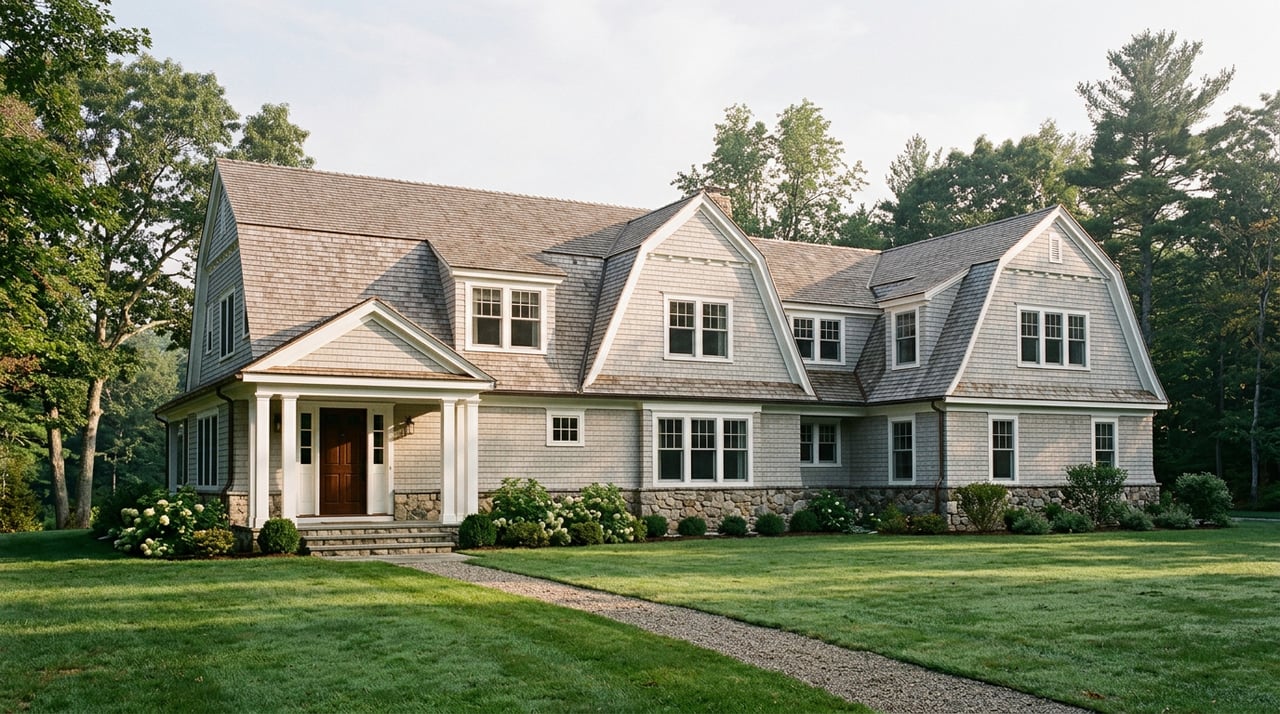
A house near the center of Kennebunkport's historic district went through a full restoration a couple of years back. Built around 1810, it had sat in disrepair before new owners brought in Spang Builders and designer Ryan Donnelly to bring it back. They kept the original wide-plank pine floors, the staircase, the settling in the moldings that comes from two centuries of a house doing what houses do. It was careful, deliberate work, and it happened because the owners wanted it that way. Not because anyone made them.
That last part is the piece most buyers miss. If you're looking at a home inside Kennebunkport's Village Historic District and assuming the designation comes with a review board looking over your shoulder on every exterior change, it doesn't. There is no commission you have to appear before. No certificate you need before you swap out siding, add a dormer, or tear the whole thing down and start over. The district's National Register listing, which hits its 50th anniversary this year, was never built to do that.
What the listing actually did in 1976
The story behind the designation is worth knowing before you assume anything about what it protects. In January 1975, KHS President Mary Bryant, board director Gertrude Maling, Port Planning Board chairman Wally Reid, and Maine State Historic Preservationist Frank Beard met to plan an application. Beard photographed the properties and filed the paperwork with the National Register of Historic Places that July. The district was accepted on May 6, 1976, timed to land during the Bicentennial, and a certificate signed by Earle Shettleworth Jr. went to the town.
That's a meaningful piece of local history. It is not, and was never intended to be, a set of teeth. The Kennebunkport Historical Society said it plainly in a post marking the anniversary this year:
"Though it offered no protection against historically inappropriate alterations or demolitions it prevented federal funds being spent to cause harm within the district."
Read that again if you're evaluating a property in the district. The listing kept federal money from funding harmful projects like road widening through historic blocks, and it opened the door to some limited restoration matching funds at the time. It did not give anyone the power to stop a neighbor, or you, from tearing a 200-year-old house down.
Why the town never built the version with teeth
This wasn't an oversight. Town planners and KHS officers tried for years to get a real Village Historic District ordinance on the books, the kind that would require design review before exterior work. Port voters turned it down repeatedly. Planning documents from the town's own Growth Planning Committee acknowledge the pattern directly, noting that the committee expected any preservation ordinance to fail at the ballot box given the town's history of voting against zoning measures generally. The National Register application was, by the Historical Society's own description, a consolation step taken because the real version wasn't going to pass.
Fifty years later, that choice still shapes what you can and can't count on if you buy inside the district lines.
The town next door did it differently
Compare that to Kennebunk, just across the river bridge. Kennebunk's Historic Preservation Commission issues Certificates of Appropriateness for properties in its Historic Preservation Overlay District, and its zoning ordinance is specific about what that means. No building or structure in the district, including fences, walls, steps, and landscaping, can be altered, reconstructed, moved, or demolished without one first. The commission meets on the second and fourth Wednesday of each month, and any application requires ten days of advance notice to abutting property owners before it's heard.
Here's the practical difference laid out side by side:
| Kennebunkport Village Historic District | Kennebunk Historic Preservation Overlay District | |
|---|---|---|
| Legal basis | National Register listing only | Local zoning ordinance (Article 12) |
| Review before exterior changes | None required | Certificate of Appropriateness required |
| Demolition restrictions | None | Requires commission review |
| Abutter notice | Not applicable | 10 days before hearing |
| What it actually prevents | Federal funds harming the district | Unreviewed alterations or teardowns |
If you're comparing a listing in Kennebunkport to one in Kennebunk and assuming both carry the same renovation constraints because both sit inside a "historic district," you're comparing two different legal realities that happen to share a label.
What that freedom looks like in practice
The 1810 restoration near the district's center is one example of how much latitude owners actually have. Another is the Billows Cottage, an 1895 shingle-style home near Walker's Point that recently went through a full gut renovation with Spang Builders and designer Theofanidis. The team added structural support, restored the original rock foundation, put on a new roof and new shingle siding, and enlarged windows to open up the ocean views. That's a significant amount of exterior change on a historic property, executed without a design review board weighing in on window proportions or roofline pitch.
For a buyer who wants a historic-district address without inheriting a bureaucratic layer of design approval, that's a real advantage. You can plan a renovation around your own priorities and your architect's judgment rather than a commission's preferences for materials and detailing. It's also faster. There's no ten-day notice period to abutters, no waiting for the next scheduled Wednesday hearing, no risk that a commission asks for revised elevations before you can pull a building permit.
The trade-off you're also buying into
The same freedom that lets an owner restore a 1810 house with care lets another owner tear one down. The Historical Society's own anniversary post doesn't shy away from this. Writing about the 50th year of the listing, the author notes thinking about the historic Kennebunkport properties that have already been demolished or transformed into modern mansions. The district holds 147 buildings on the National Register nomination, and only 24 of them were built after 1925. That's a streetscape built almost entirely before the mid-1920s, sitting inside a legal framework that does nothing to keep it that way.
If the reason you want a home in this specific district is the continuity of the block, the sightlines, the sense that the house next door will still look like it belongs in 1890 in twenty years, that continuity depends entirely on the choices of individual owners, not on any commission standing behind you. It has held up for fifty years partly by luck and partly because enough owners have chosen restoration over replacement. There's no ordinance guaranteeing it holds for the next fifty.
What to actually confirm before you write an offer
If you're looking at a property inside the Kennebunkport Village Historic District, a few things are worth confirming directly rather than assuming from the label:
- Whether the specific parcel is inside the National Register boundary at all, since the district lines don't always match popular assumptions about which streets are included
- Whether the property carries any separate protections tied to state or federal restoration tax credit programs, which can come with their own maintenance conditions distinct from the district listing itself
- What renovation work, if any, has already been done to the house and by whom, since builders and designers who've worked on historic properties in this specific district tend to understand the structural quirks of 19th-century construction better than a crew coming from a generic renovation background
None of this is a reason to avoid the district. It's a reason to walk in with an accurate picture of what the label does and doesn't guarantee, so you can make your renovation plans, or your expectations about the block staying the way it looks today, based on how the town actually works rather than how the phrase "historic district" sounds.
A few common questions
Does a National Register listing affect property taxes in Kennebunkport? The listing itself doesn't set tax policy. Some restoration work tied to historic tax credit programs can come with separate financial considerations, which is worth a conversation with a tax professional before you rely on it as part of your renovation budget.
Can I add on to a historic home in the district without any town review? Standard building permits and zoning setbacks still apply the way they would anywhere else in town. What's absent is a separate historic design review layer requiring approval of materials, window styles, or roofline changes before that permit gets issued.
Is Kennebunkport considering a local preservation ordinance now? Nothing in the current research points to an active ballot measure. Given the town's history with this exact question, it's worth watching town meeting warrants if the topic matters to your decision.
If you're weighing a historic Kennebunkport property, whether you're drawn to the freedom to renovate on your own terms or you want a clear-eyed read on what protects the block's character and what doesn't, I can walk you through what a specific address actually sits inside. Shanna Jadooram — Let's Connect.